
THE BOOK OF REVELATION, PART II:
- brittbryan1001
- Jun 2, 2024
- 6 min read
Updated: Jun 8, 2024
Reading someone else's mail.

In Part 1 of this three-part series, I talked about the dangers of misreading Revelation and the importance of developing a truer and better understanding of this last book of the Bible. My hope in writing this series is that it can bring some relief to those who have struggled to understand it and feared its meaning. Because when we have better information, we will arrive at a better understanding.
So, in Part 2 and 3 of this series, I want to continue the conversation about what Revelation is and what it isn’t, by unpacking five of the most common misunderstandings of this wonderful and complicated book.
#1: IT’S A LETTER, NOT A MAP

Revelation was a letter written by a man named John (which John, or which group of authors under the school of John, is a matter of debate) to a very specific group of people: the seven churches in Asia Minor (Rev 1:4).
The intention of his letter was to encourage those early Christians to stay faithful, even in the midst of their persecution under the Roman Empire (Nero was the emperor of Rome, remember his name…it will be very important in the next point…).
So, while we can and should apply its wisdom to our own lives, to encourage us to stay faithful in the midst of our own trials, it was not written to us in twenty-first century America. We are reading someone else’s (very ancient) mail.
Further, we are not meant to read the letter as if it is communicating literal, historically factual events. This is made clear in the opening lines when John refers to this letter as prophecy.
We tend to think prophecy means a telling of the future, but that’s not accurate. Prophecy actually means “to proclaim.” Like how the prophets of the Hebrew Scriptures (the Old Testament) called Israel to repentance. Their job was not to pronounce the future, but to interpret and communicate - to proclaim - the will of God, which they often did by using poetry to make their point.
In a similar way, John uses symbols and metaphors to interpret and describe what he has seen in a dream. He was not foretelling an exact future that would eventually unfold; but was attempting to illustrate a reality currently unfolding, but impossible to explain in any other way. (More on this in the third point, so check back in for Part 3.)
While Revelation is a letter and it is considered a prophetic book, it is also what is known as “Apocalyptic literature.” There is much to be said about this literary style, but in the interest of keeping the length to a blog and not a novel, I will just link to what The Bible Project has to say about it: Apocalyptic Literature.
The most important thing to note here is that Jewish Apocalyptic Literature communicates through symbolism and poetic imagery. And so, we should read Revelation in light of these literary styles, not literally.
Which brings me to my second point.
#2: IT'S SYMBOLIC, NOT LITERAL

Here’s what I’m not saying: Revelation is just symbolic so we should ignore it.
Not at all. I do think we’re meant to look at and interpret the meaning behind the symbolism; just not like it’s a treasure map pointing us to clues about the end of our world today. We need to understand the context of the world in which this letter was written.
To show what I mean, I want to go over three examples that highlight how symbolism works in Revelation: the mark of the beast (666), hell, and Satan.
First, the mark of the beast.
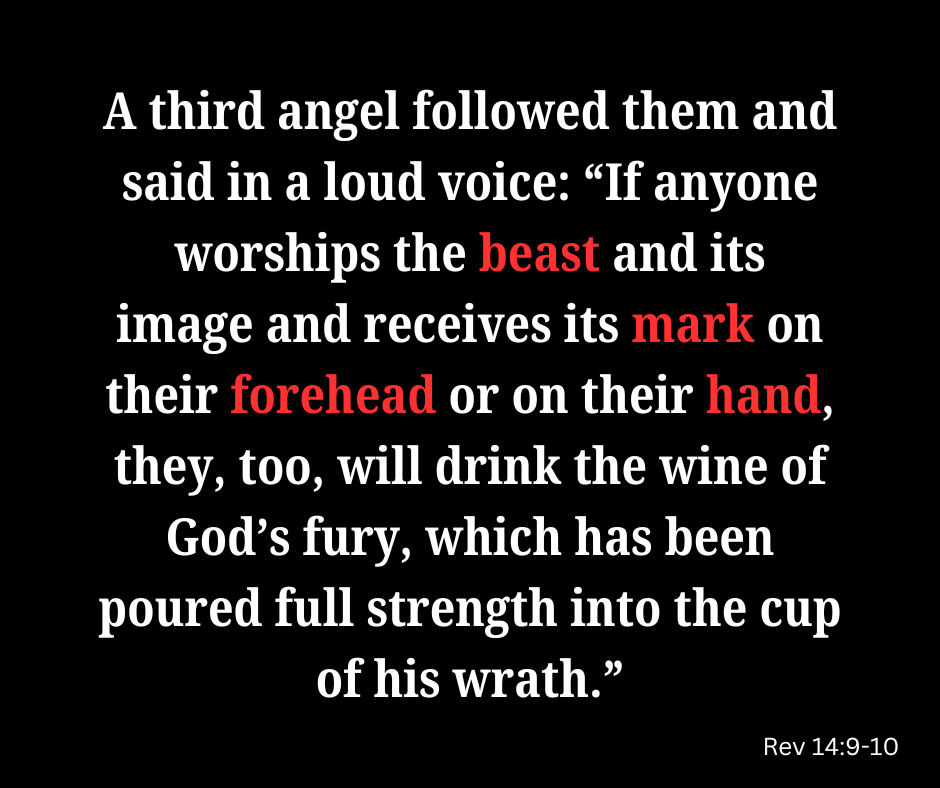
Some people today think the US government is "the beast" and they "mark" us with Social Security numbers, microchips, or “the jab” (the Covid-19 vaccine). I can tell you with 100% certainty this is not the case, based on nearly universally accepted biblical interpretation of what "the mark of the beast" is actually referring to. Because there is an explanation that would have made total sense to John's original audience.
To explain what “the mark of the beast” is referring to, we need to be familiar with the overall backstory of the ancient Israelites. Which is that they could serve no god other than the God of Abraham, but were constantly being enslaved by other nations (think Egypt, Assyria, Babylon) that demanded their allegiance. And according to John, that is what made the rebellious nations "beasts." Hold that thought, because there is something else we need to know before moving on.
As a reminder to stay faithful to their one and only God, the Israelites said this prayer called "the Shema," which they would write on their forehead and hand as an expression of their allegiance to God.
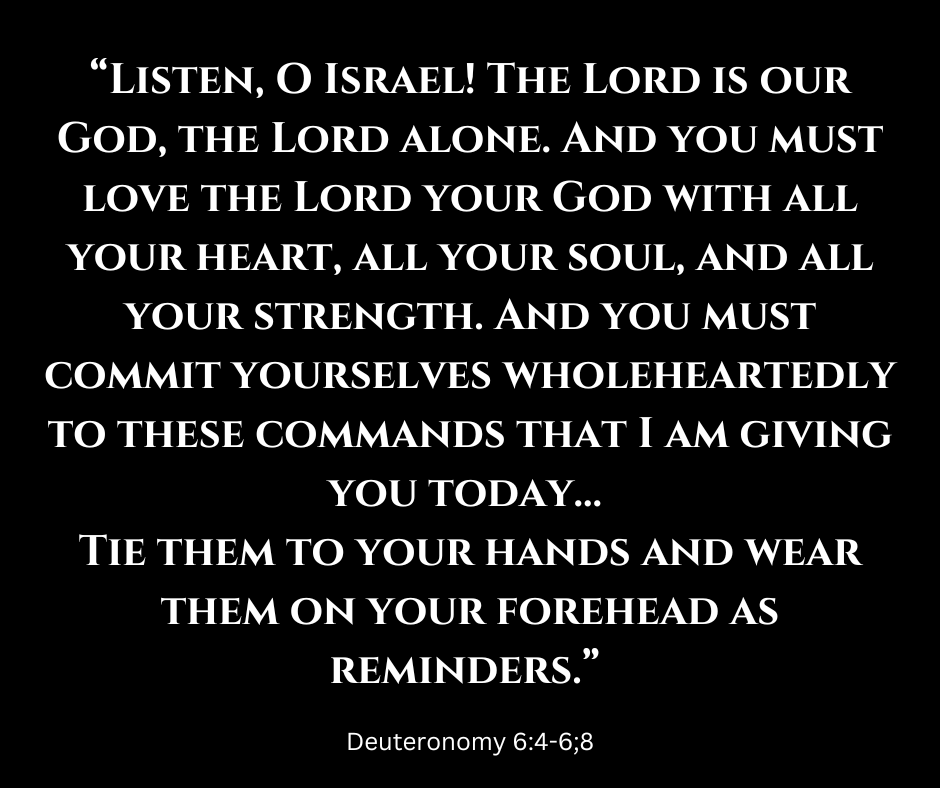
And so in John's Revelation when he says, "Anyone who worships the beast and his statue or who accepts his mark on the forehead or hand...." (Rev 14:9-10), his audience would immediately see the connection to the Shema. They would understand that John was warning them that other nations would demand their allegiance - thereby becoming "beasts" - but that they must stay faithful no matter what.
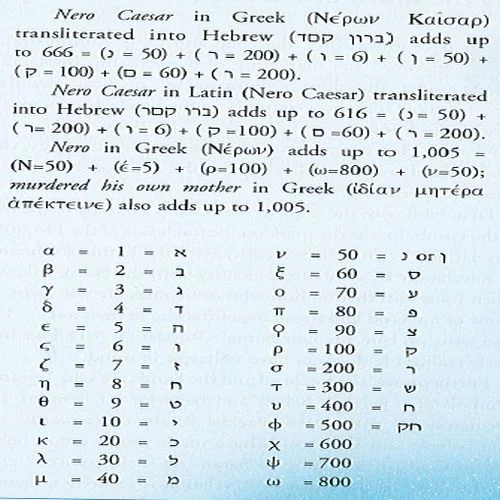
John's audience would also immediately understand the symbolism behind his use of the number 666 to represent "the beast." Revelation 13:18 tells us that the number of the beast is the number of a man, and that number is 666.
Who is the man this number represents? All biblical scholars agree that "666" symbolized NOT the devil or Satan, but Nero, the famously cruel emperor (Caesar) of Rome at that time.
This one is actually a very simple explanation. Hebrew letters are also numbers, and if you spell “Nero Caesar” in Hebrew, you get 666. That's it. No big mystery at all.
Now let’s talk about hell.
Because this may come as a shock or surprise, but there is no concept of hell in the scriptures, at least not in the way we understand hell today.
This is just another way we misunderstand the Bible. Hell is an idea that has evolved over time, inspired in part by a misapplication of ancient ideas about death and the underworld, along with imagery from the book of Revelation, to create this idea of hell as a place some people go to after they die.
There is MUCH more to say about where we get our concept of hell, but for today's purposes, I will just give one example to show what I mean.
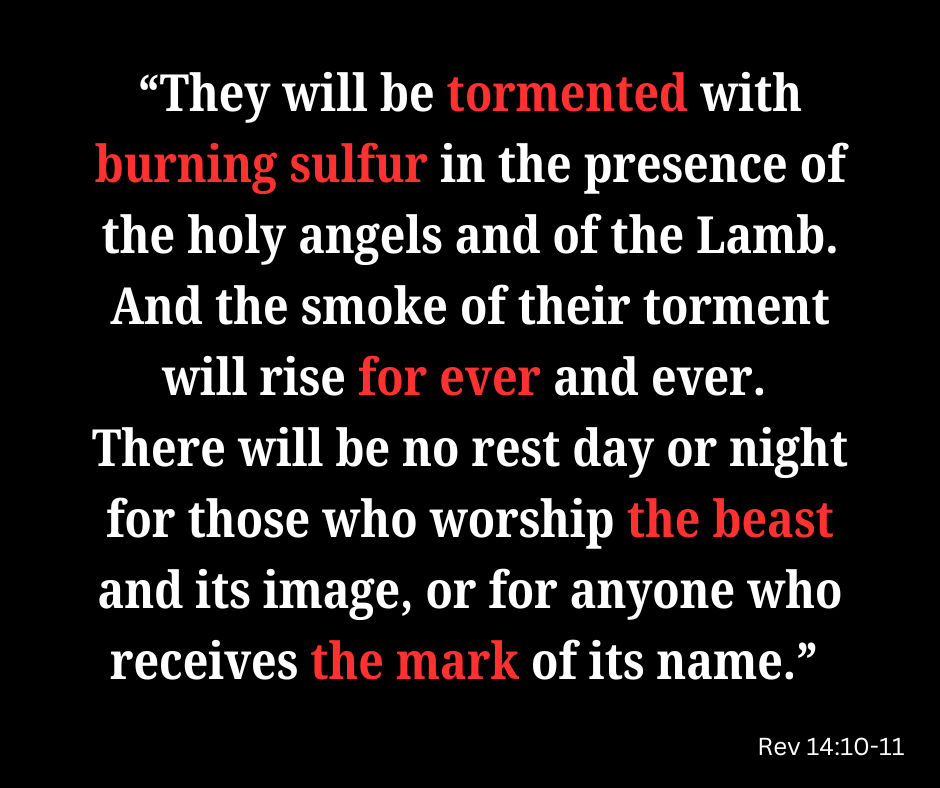
Once again, John's audience would have immediately seen the connection of Revelation’s images of fire and sulfur to the fire set on Sodom and Gomorrah (Genesis 19:24). Because what happened in Sodom and Gomorrah was they disobeyed God and gave their allegiance away to selfish desires. (We should be thinking of Rome again here…)
“The purpose of the motif of the firestorm here…is to emphasize the long-term consequences of worshipping the beast.” - TJ Wray and Gregory Mobley, The Birth of Satan
And so hell is not a place you go to burn in a pit of eternal flames. Hell is what happens when you give your allegiance to anything that opposes God.
Which brings us to "Satan."
And again, there is MUCH to say about this topic, all I will say for now is that "Satan" is not the name of a person or a singular being, but the amalgamation of all the evil in the world. In other words, "Satan" is the idea of evil at large.
A symbol, you could say.
To recap these three examples of symbolism in Revelation, "the beast" represents opposition to God, and "hell" is its consequence. So, the way we ought to read Revelation today is not to figure out which political leader is "Satan" or the "Anti Christ" and which famous celebrity is the sea monster or dragon...and it's not to search our world today for symbols and numbers to connect to some misguided "End Times" theology.
Its message for us today, at least I would venture to say, is to ask ourselves this question:
What empires are demanding our allegiance?
The Revelation of John is telling us that when we swear allegiance to “Rome” - meaning any empire that opposes God’s kingdom - we are entering a cosmic battle. That battle is what is being revealed in this letter.
Which leads into the next point….but you will have to check back in for Part 3 for the final three misunderstandings of the book of Revelation.

(All sources used will be linked to at the end of Part 3.)


Comments