THE BOOK OF REVELATION, PART I:
- brittbryan1001
- May 31, 2024
- 7 min read
(and the End of the World as we know it...)
When I was a little girl, I remember looking out at the ocean and assuming it ended at the exact point where I could no longer see it, where it obviously dropped off into an enormous waterfall. I was deeply concerned for the boats that got, in my opinion, far too close to its edge, but I just knew it was a place I personally never wanted to get near.
But when I got a little older, I learned that the earth was actually round and there was this force called gravity that held everything in place. So, I happily updated my belief about the “edge” of the ocean and was no longer afraid (until my older sisters let me watch Jaws, which is why I still don't go in the ocean...).

My understanding had been incomplete as a kid, because I didn’t have the full story. But when new information came to light, it filled in the gaps of my previous knowledge and provided a better explanation.
But new information isn’t always welcome. Sometimes new information is unsettling and upsetting and forces us to wrestle and reckon with our existing beliefs and convictions.
Like when I was in elementary school, we’d reenact the first Thanksgiving by dressing up as “Pilgrims” and “Indians” and share a nice meal together to celebrate our friendship.
Then at some point, I learned the real story behind Thanksgiving. That not only should we not say “Indians” when referring to native people groups, but that first Thanksgiving was not exactly the progressive potluck dinner I thought it was.
This time, the new information was certainly not a better explanation of events, but it was a truer one. Which is just as important.
In the first example, truth was a relief. In the second one, it was vile.
In both cases, it was the discovery of new information which led me to update my beliefs. It doesn’t mean what I had been taught or what I previously believed was a lie (because trying to explain gravity and genocide to a small child is not advisable...). Rather, I was simply introduced to the complete story at the point in time which I was better equipped to receive it, and my understanding changed and expanded with new information.
The point I'm trying to make is this same process applies to the Bible. With new discoveries, better explanations, and further study of ancient cultures and languages, our understanding of the Bible deepens in our ongoing quest to get closer and closer to “the truth.”
Take the book of Revelation, for example.
There will always be some people who stubbornly cling to their original beliefs on Revelation, despite overwhelming evidence to the contrary. They read Revelation literally to try and decipher the “signs” that point to the destruction of the world.
And when we read Revelation that way, like it’s a secret code to crack about the timing of the end of the world, that’s when events like war in Israel, the Covid-19 vaccine, earthquakes, famines, climate change, and inflation inspire proclamations that these are “signs of the End Times.”
The truth is that plagues and viruses and death and war and destruction are occurring all over the world, most devastatingly and consistently in developing countries. Yet, it’s only when that stuff happens here in America that we think it’s a sign of the “Apocalypse,” or the “Great Tribulation.” Which has led to an unfortunate and harmful false belief in the “Rapture” and being “Left Behind.” The original "Fake News."
And in our modern world where people increasingly get their news from social media platforms…a breeding ground for misinformation…false claims spread faster than wildfire.
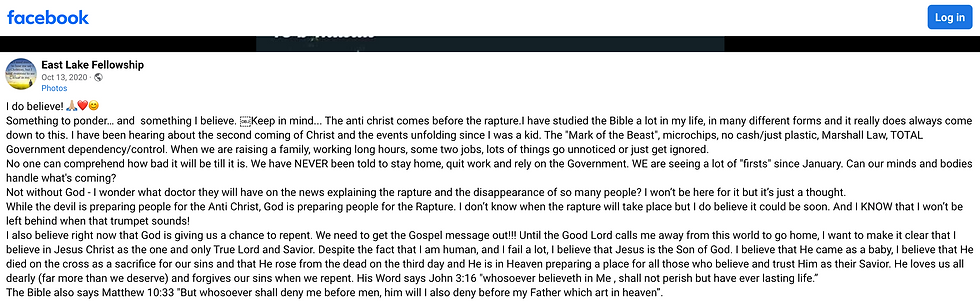
Like this #FacebookChallenge, for example. Which is typical of thousands of others you can find, about signs of the “End Times.” You are supposed to share this post to make sure everyone knows you are a Christian when the "Rapture" begins.
Here's the first half of the post:
"Just something you might want to ponder deeply if the anti christ comes before the rapture. I am studying the Bible and it really does always come down to this. I have been hearing about the second coming of Christ and the events unfolding since I was a kid. The "Mark of the Beast", microchips, no cash/just plastic, Marshall Law, Total Government dependency/control. When we are raising a family, working long hours, some two jobs, lots of things go unnoticed or just get ignored.
No one can comprehend how bad it will be......till it is. We have NEVER been told to stay home, quit work and rely on the Government. WE are seeing a lot of "firsts" since January. Can our minds and bodies handle what's coming?
Not without God - I wonder what doctor they will have on the news explaining the rapture and the disappearance of so many people? I won’t be here for it but it’s just a thought.
While the devil is preparing people for the Anti Christ, God is preparing people for the Rapture. I don’t know when the rapture will take place but I do believe it could be soon. And I KNOW that I won’t be left behind when that trumpet sounds!
The way people shared this “Challenge” with such fervor made me realize a couple things:
First, the obvious political undertones of this FB post only encourages the growing divide between opposing groups in our already deeply polarized country. It furthers the narrative that we must pick a side: Republican (Christian) or Democrat (Heathen), which does nothing to advance the message of the gospel.
And second, this post is an example of how bad information perpetuates misunderstandings of Revelation, and thus, a misunderstanding of God. It highlights the problem that there simply isn’t enough information out there to combat this unfortunate view of Revelation.
Actually, there's a ton of scholarship out there about the book of Revelation, but people may not be aware of it. Plus, it’s not always easily accessible and can be difficult to understand.
But I think there is another reason some people prefer to cling to the belief that Revelation is about the end of the world and who's going to heaven and who's going to hell......
Fear.
I think people are afraid of updating their beliefs because of a (false) assumption that if you doubt or question one part of the Bible, then the entire thing is called into question. For some, that feels overwhelming and uncomfortable at best, and blasphemous at worst.
My response to people in that camp is: I get it. I understand where you are coming from. When I first started my own process of unlearning what I'd been taught about the Bible, I felt as if my faith was unraveling and I was scared I might lose it altogether.
But that's not what happened. What happened was that my faith came more alive than ever. It felt richer and deeper and most importantly - truer - when I gained a better understanding of what was actually going on in the story of the Bible.
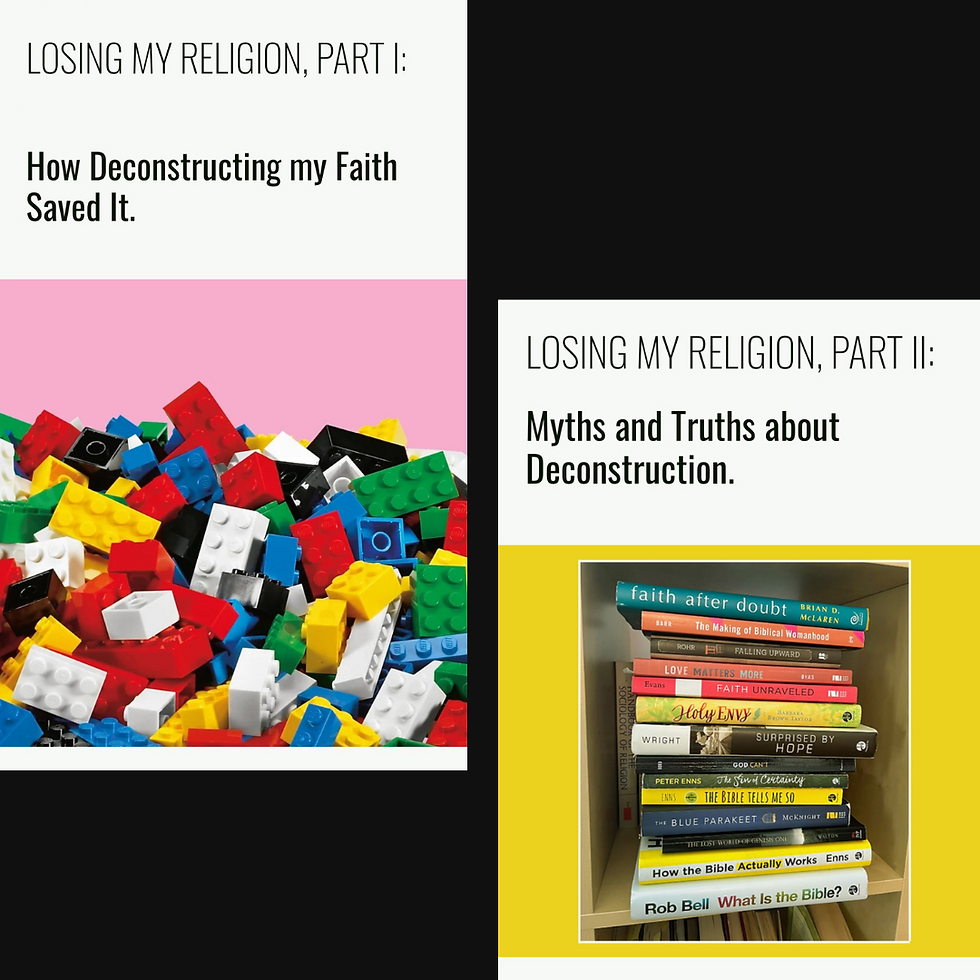
(If you're interested in that story, I wrote a two-part blog about my own experience with deconstructing my faith. Some people are uncomfortable with that word, deconstruction; I'm not. But if it helps, think of it as a reconstruction instead.)
Before, I saw the Bible as "required reading" for any professing Christian, but I honestly avoided reading it because I was so intimidated by it - especially Revelation. And now, the Bible is my most treasured and favorite book.
So, I just want to help unpack some of the most misunderstood ideas about Revelation by offering what I have learned in my own study, and hope that it can bring some relief to those who have also struggled to understand this book and feared its meaning.
Because when we have better information, we will arrive at a better understanding.
All of this has been my way of introducing the topic of Revelation and why I see a need to talk about the misunderstandings associated with it. In Part 2, I will get into the main ways we misread and misunderstand the book of Revelation.
But first, I just need to mention two things that are important to accept before moving forward.
One: let’s start by accepting the fact that Revelation is a tricky, complicated, confusing, and super-weird book. We cannot fully conquer or tame it. Nor should that be our goal. The very essence of Revelation is that it gives us something to wrestle with and ponder and meditate on and consider.
But that doesn't mean that we should just ignore it and remain in our confusion. We can discover explanations of Revelation that are truer and easier to grasp and digest if we are willing to do the work.

And two: the word Revelation. It’s extremely important to know what it means.
The New Testament was written in Greek. “Apocalypse” is the Greek word that translates to “Revelation” in Hebrew. Both apocalypse and revelation mean “to reveal” or “unveil.”
But somewhere in the 19th century, its meaning shifted to the “belief in an imminent end of the present world.” Which is the short story of how the meaning of the word “apocalypse” came to be associated with “the destruction of the world.”
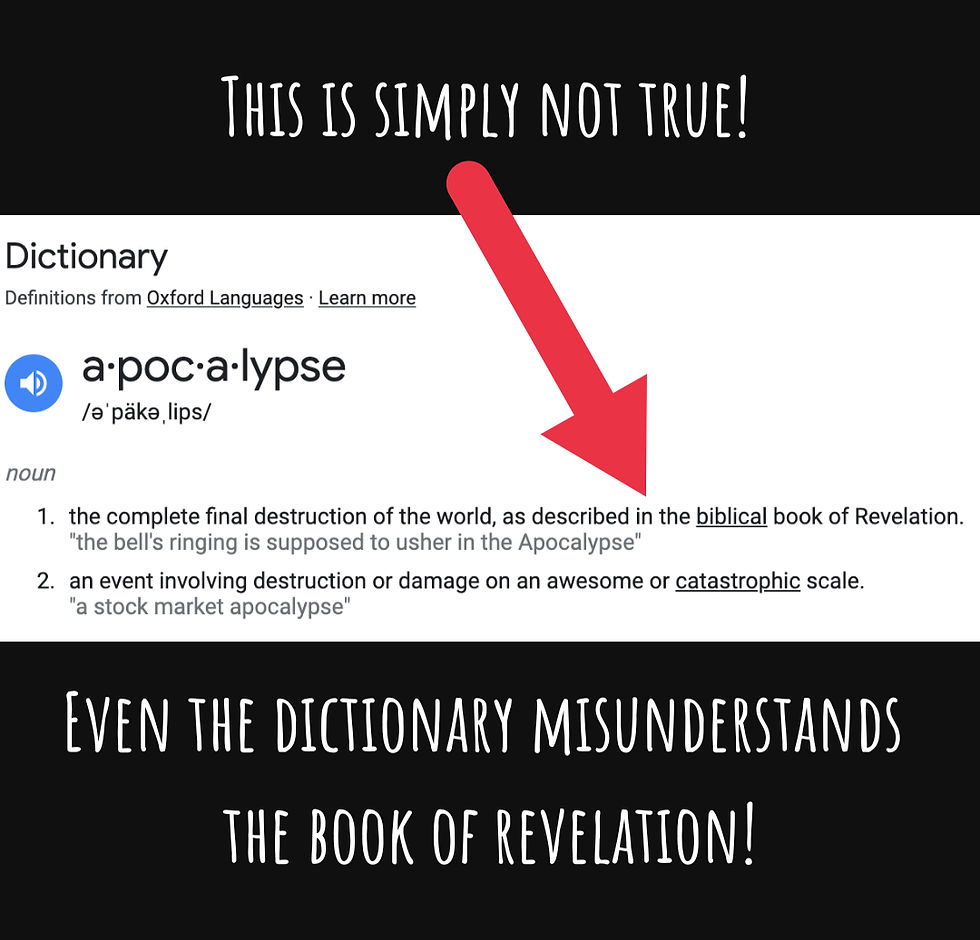
When we read modern events and ideas backwards INTO Revelation, rather than reading Revelation for what it was intended to be, we miss the whole point.
But - if we read this book with a base understanding that “apocalypse” and “revelation” mean something is being revealed or unveiled (not destroyed), it changes everything about how we read and understand this book.
(And what is being revealed? We’ll get to that in Part 2…)
While it may, ironically, feel like the end of the world as you know it to update your beliefs when it comes to the book of Revelation...and I do not take that lightly...I hope to show that it can also be liberating and life-changing in the best way.
So, if I can offer a bit of encouragement at this point, it's to remember that when it comes to the Bible, our job as Christians is to do the best we can with interpreting and applying its wisdom (under the guidance of sound biblical scholarship) to how we live our lives, while always looking to Jesus to check ourselves.
Because when nothing in the world makes sense, we can look to Jesus. And we can look to the God who so loved the world that he gave His Son to redeem and restore it - NOT to destroy it.
So, in Part 2 of this series, let’s talk about Revelation (said no one, ever!) and what it is and what it isn’t.


Comments